Integrating the Element-E Protocol into ESG Reporting Frameworks
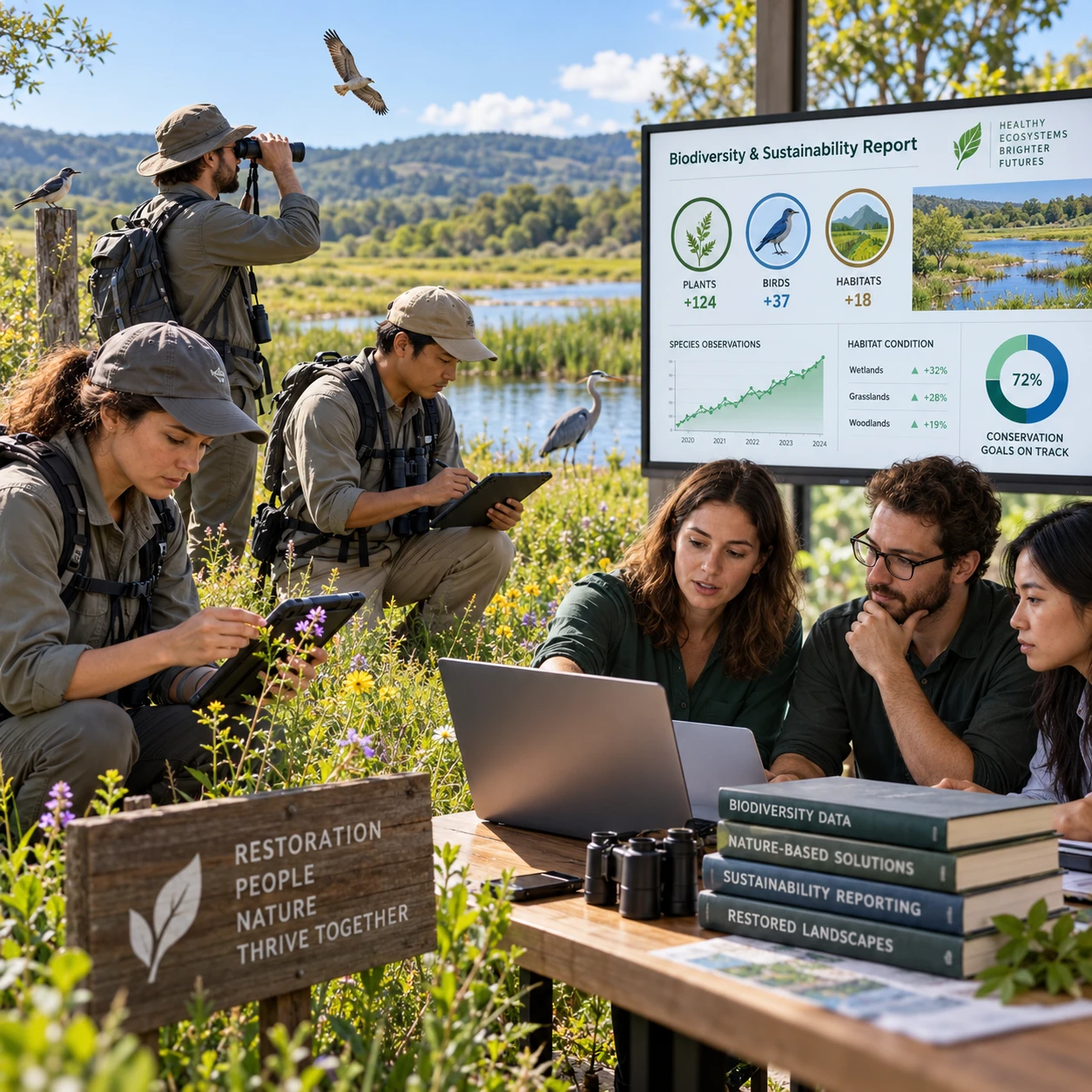
Biodiversity data can make an environmental disclosure more grounded, but only when readers can understand what was monitored, where, and how the evidence supports each claim. Integrating the Element-E Protocol into an ESG reporting framework offers a way to organize biodiversity monitoring information for reporting use while keeping the limits of that information visible.
The protocol should be treated as a monitoring and evidence-management aid, not as a guarantee of compliance or a substitute for the requirements of a chosen reporting framework. The practical task is to connect field data, biodiversity indicators, and environmental disclosure through a traceable process.
Why biodiversity monitoring belongs in ESG reporting
Biodiversity monitoring belongs in ESG reporting because it can show how ecological conditions change within a company’s defined reporting boundaries. When the monitoring method and context are clear, observations help stakeholders assess environmental impacts, risks, and management responses.
A statement that a site has high ecological value means little without evidence about habitat, species, pressure, and change over time. Monitoring can provide that evidence through observations such as species presence, habitat condition, invasive species, or signs of disturbance. These findings may support biodiversity-related disclosures, but they do not automatically describe every ecological effect of an organization.
The reporting connection is strongest when teams explain why a location was monitored and how it relates to operations or supply-chain activity. A site-level survey, for example, may describe conditions within a project area; it cannot establish a company-wide biodiversity trend unless the sampling design supports that broader conclusion. Define the **reporting boundary** before drawing conclusions, and distinguish direct operational sites from other areas of influence.
Frameworks and disclosure requirements differ, and they may change. Use the relevant framework’s current guidance to determine which topics and metrics apply. Biodiversity monitoring contributes evidence to that process; it does not decide materiality or replace the organization’s reporting obligations.
What the Element-E Protocol contributes
The Element-E Protocol contributes a structured way to organize biodiversity monitoring information so teams can review and use it in reporting. Its value depends on how well its outputs are connected to documented methods, locations, dates, and reporting claims.
In practice, a protocol can help make the chain from field data collection to disclosure easier to follow. Teams should identify which outputs the protocol produces in their implementation, then record the associated survey effort, observation conditions, and review steps. Avoid assuming that the protocol prescribes a particular indicator, sampling frequency, or compliance result unless its official documentation confirms that requirement.
This distinction matters: a repeatable monitoring approach can improve consistency, but consistency alone does not prove that a survey represents all habitats or seasons. The protocol’s outputs may be useful for organizing records, comparing observations under suitable conditions, and flagging information gaps. They remain evidence with a defined scope.
Before using the protocol, assign responsibility for data capture, validation, interpretation, and disclosure approval. Keep original records alongside summaries. That gives reviewers a way to trace a reported figure or statement back to the field evidence rather than relying on an unsupported narrative.
Map protocol outputs to ESG indicators
Map Element-E Protocol outputs to ESG indicators by documenting how each observation supports a reporting topic, rather than assuming every output has a direct one-to-one match. The right link depends on the indicator’s definition, the monitoring method, and the scale of the evidence.
A useful mapping table can include the protocol output, potential biodiversity indicator, reporting topic, location and time period, interpretation, and caveat. For example, repeated observations of a focal species may inform a presence or distribution measure, while a habitat-condition assessment may support a statement about the condition of a monitored area. Neither measure alone proves that biodiversity has improved because of a company’s actions.
- Observation: What was recorded, such as species presence or a habitat feature?
- Indicator: What measurable signal can be derived, and how is it defined?
- Disclosure: Which reporting topic or claim could the indicator support?
- Qualification: What does the evidence not establish, and what context must accompany it?
Check whether an indicator calls for a site-level measure, a change over time, or an organization-wide result. A handful of species observations may describe a survey, but they may not support a claim about ecosystem condition. Likewise, a positive result at one site should not be presented as proof of net biodiversity gain across a portfolio.
Build a consistent monitoring-to-reporting workflow
Build a consistent monitoring-to-reporting workflow by setting the reporting question first, establishing a baseline, collecting comparable field data, reviewing results, and then preparing the disclosure. This sequence helps teams avoid collecting data that cannot answer the question they ultimately report.
1. Define scope and baseline
List the sites, operations, habitats, and time periods covered. Record why each site was selected and identify known pressures or management actions. A baseline assessment should state its date, survey coverage, and methods; it is a reference point, not a claim that conditions are pristine or fully understood.
2. Plan field data collection
Choose methods that fit the target taxa and habitat, and document survey timing, effort, equipment, and observer qualifications. Where possible, retain consistent methods across monitoring rounds. Seasonal variation, weather, access, and observer differences can affect results, so note them rather than treating every survey as directly comparable.
3. Review and interpret
Check records for missing fields, duplicates, unusual values, and mismatches between locations or dates. Have a qualified reviewer assess whether the proposed indicator follows from the data. Separate observations from interpretations and interpretations from management claims.
4. Prepare the disclosure
Connect each reported statement to its source dataset, method, boundary, and review record. Keep a clear audit trail, including any adjustments made during analysis. This workflow takes planning time, but it reduces the risk of having to reconstruct methods when a report is reviewed.
Address data quality, boundaries, and limitations
Address data quality, boundaries, and limitations by reporting how the evidence was collected, what it covers, and where uncertainty remains. Transparent qualification makes a biodiversity disclosure more useful than a precise-looking number without context.
Data quality and comparability depend on method consistency, sampling effort, taxonomic identification, and complete metadata. A result from one season may not be comparable with a result from another if survey timing or effort changed. If methods changed, explain the difference and avoid presenting the values as a continuous trend unless they can be reconciled defensibly.
Boundaries also shape what a result means. State whether monitoring covers a facility, a project footprint, a buffer area, or a wider landscape, and explain exclusions. For locations where access or resources limited fieldwork, report the gap instead of implying that no biodiversity was present.
- Describe the method, survey dates, effort, and relevant qualifications.
- Identify the geographic and organizational reporting boundaries.
- Explain uncertainty, incomplete coverage, and known data gaps.
- Distinguish measured results from estimates, interpretation, and future targets.
Do not convert missing observations into evidence of absence. Nor should a protocol output be described as independently verified unless an actual verification process occurred. These distinctions protect credibility and help users understand what further monitoring is needed.
Communicate results and support ongoing improvement
Communicate biodiversity monitoring results with their location, period, method, and limitations, then use them to improve future monitoring. A clear disclosure helps readers understand both the ecological finding and the confidence they should place in it.
Present the result before the interpretation: for example, report what was observed at the monitored site during the stated survey period, then explain whether it suggests a change and what factors may have influenced that change. If evidence is too limited to establish a trend, say so plainly. Avoid implying causation where the data only show an association or a single observation.
Use reporting review as a feedback loop. If a disclosure relies on a measure that proved difficult to compare, refine the next survey plan, metadata fields, or sampling schedule. If results reveal a gap in site coverage, prioritize that area in the next monitoring cycle. The trade-off is straightforward: broader coverage can require more time and resources, while narrower coverage calls for narrower claims.
Keep a record of changes to indicators and methods from one reporting period to the next. That history helps readers interpret trends and lets internal teams improve the monitoring-to-reporting workflow without erasing earlier limitations.
Frequently asked questions
What information should be collected before integrating the protocol into ESG reporting?
Collect the reporting boundary, site list, relevant habitats and pressures, baseline assessment, monitoring methods, survey dates and effort, and available protocol outputs. Also identify the reporting framework and indicator definitions you intend to address. This preparation shows whether existing evidence is suitable or whether additional field data collection is needed.
How can biodiversity monitoring data be linked to ESG indicators?
Define the indicator first, then map the monitoring observation to it and document the location, period, method, and limitations. A link is defensible only when the data measure the indicator’s stated subject at an appropriate scale. If the match is partial, explain that rather than forcing a direct equivalence.
How should gaps or limitations in monitoring data be reported?
State what is missing, why it is missing, which sites or periods are affected, and how that limits interpretation. Distinguish incomplete coverage from a finding of no biodiversity. Where practical, describe the planned action to address the gap, without presenting that future work as completed evidence.
How often should biodiversity data be reviewed for reporting?
Review data after each monitoring round and before each reporting cycle, with additional checks when methods, boundaries, or indicators change. The appropriate field monitoring frequency depends on ecological conditions, survey purpose, and reporting needs; there is no universal interval that fits every site. Keep review frequency and field survey frequency distinct.