How AI and IoT Are Revolutionizing Biodiversity Data Collection
Biodiversity is collapsing faster than we can measure it. That gap between ecological reality and available data has long been one of conservation's most stubborn problems. But a convergence of artificial intelligence and Internet of Things technology is beginning to close it — not just for field ecologists, but for farms, land managers, and corporate sustainability teams who need credible, auditable biodiversity intelligence at scale.
Why Traditional Biodiversity Monitoring Falls Short
Manual biodiversity surveys are slow, expensive, and difficult to replicate at the spatial and temporal scales that meaningful monitoring requires. A trained ecologist can cover only so much ground in a day, and seasonal surveys capture snapshots rather than continuous ecological change.
The deeper problem is consistency. Different surveyors apply different methods. Weather, observer fatigue, and access constraints introduce variability that makes it nearly impossible to compare data across sites or years with confidence. For corporate biodiversity measurement or regulatory compliance, that variability is a serious liability.
Traditional methods also struggle with scale. A farm spanning hundreds of hectares, or a supply chain touching dozens of landscapes, simply cannot be monitored manually with any frequency. The result is that most organizations either rely on coarse proxy indicators or produce biodiversity reports that lack the granularity to drive real decisions.
How IoT Sensor Networks Capture Real-Time Field Data
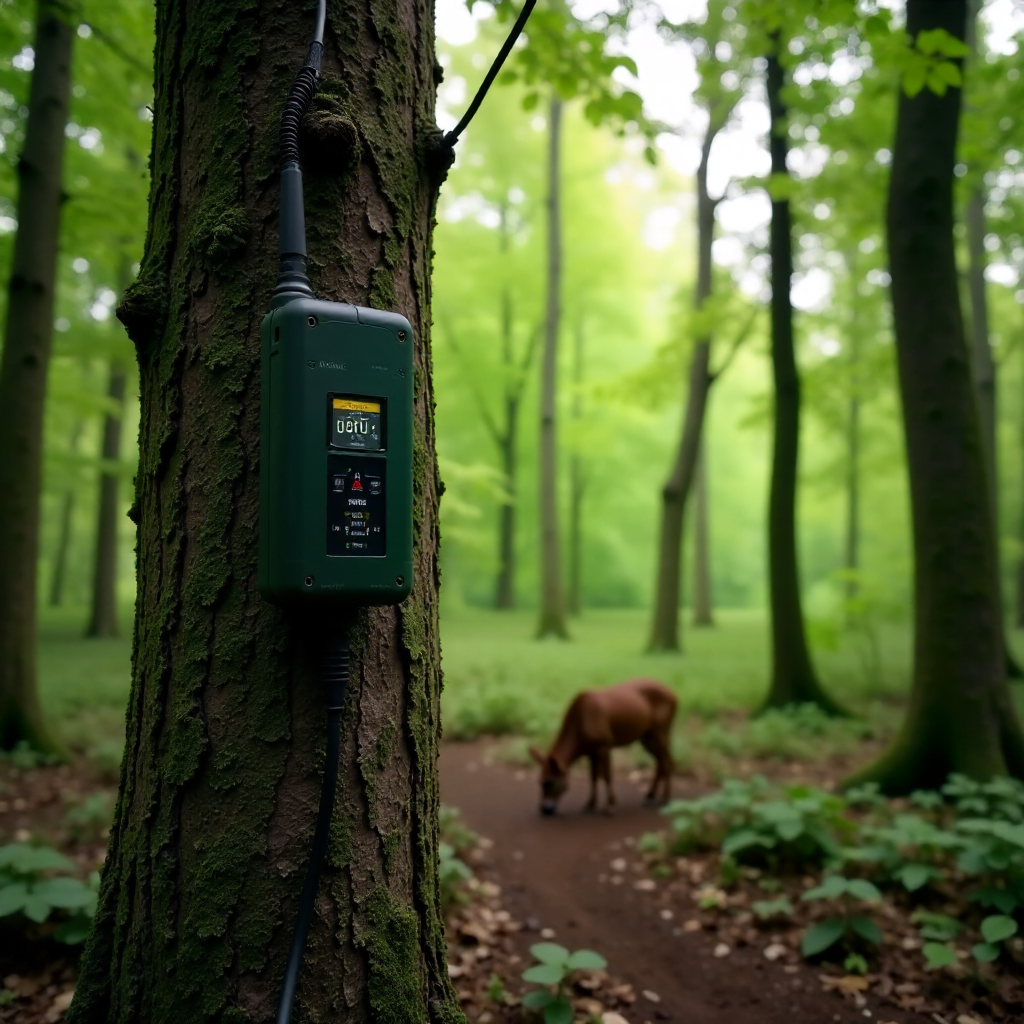
IoT sensor networks solve the coverage and continuity problem by deploying connected devices that collect species and habitat data around the clock, without human presence in the field. These aren't experimental prototypes — they're increasingly field-proven tools used across conservation and agricultural monitoring programs.
The most widely deployed device types include:
- Bioacoustic sensors — passive audio monitors that record soundscapes continuously, capturing bird calls, bat echolocation, insect activity, and amphibian choruses. A single device can detect dozens of species per night that a human surveyor would miss entirely.
- Camera traps with cellular connectivity — motion-triggered image capture with near-real-time data transmission, enabling mammal and reptile presence monitoring without site visits.
- Soil and microclimate sensors — measuring moisture, temperature, pH, and organic matter as habitat quality proxies that correlate with invertebrate and plant biodiversity.
- Water quality monitors — deployed in riparian zones to track indicators linked to macroinvertebrate and fish communities.
The connectivity layer matters as much as the sensors themselves. Edge computing — processing data directly on the device before transmission — reduces bandwidth requirements and enables deployment in remote areas with limited connectivity. A bioacoustic recorder in a forest can pre-filter audio locally, sending only flagged recordings rather than terabytes of raw sound.
The Role of AI in Processing and Interpreting Biodiversity Data
AI transforms raw sensor output into structured, interpretable biodiversity intelligence. Without machine learning, the volumes of data generated by IoT networks would overwhelm any analysis team — a single acoustic monitor can produce hundreds of hours of audio per week.
Modern machine learning models trained on large labeled datasets can now identify bird species from audio recordings with accuracy comparable to expert ornithologists. Computer vision models classify mammals, reptiles, and insects from camera trap images, flagging species, estimating counts, and even detecting individual animals through markings or morphology.
The process works roughly like this: raw sensor data flows to a processing layer (either edge or cloud), where AI models run classification and pattern recognition. Outputs are structured as species occurrence data — timestamped, geolocated records of flora and fauna presence and relative abundance. These records form the quantitative backbone of any serious biodiversity assessment.
One important caveat: AI classification is probabilistic, not infallible. Confidence thresholds vary by species, acoustic environment, and image quality. Responsible monitoring programs use AI to accelerate data processing while retaining expert validation for uncertain identifications and novel species records. The technology augments expertise; it doesn't replace it.
From Raw Data to Structured Protocols: The Importance of Standardization
Collecting data is only half the challenge. For biodiversity data to be comparable across sites, auditable by third parties, and usable in regulatory reporting, it must be structured according to recognized monitoring frameworks. Raw AI outputs, however accurate, aren't inherently decision-ready.
This is where biodiversity monitoring protocols become essential. Frameworks like Element-E provide standardized methodologies that define which indicators to measure, how sensor placement should be configured, what sampling frequencies are required, and how species occurrence data should be aggregated into interpretable biodiversity scores.
Standardization solves several practical problems at once. It ensures that data collected on a farm in one region can be meaningfully compared with data from another site using the same protocol. It creates an audit trail that satisfies ESG due diligence requirements. And it translates complex ecological datasets into metrics that non-specialist stakeholders — procurement teams, investors, regulators — can actually use.
Without this layer, even technically excellent IoT and AI data risks becoming an expensive monitoring exercise that doesn't connect to decisions. The protocol is what turns data into evidence.
Applications in Sustainable Agriculture and Land Management
Farms and land managers represent one of the most practically important use cases for AI and IoT biodiversity monitoring. Agricultural land covers roughly half of the Earth's habitable surface, making it central to any credible nature-positive strategy.
In practice, sustainable agriculture teams are using automated biodiversity data in several ways. Acoustic sensors placed at field margins track pollinator and bird activity as indicators of habitat quality. Camera traps monitor hedgerow corridors for small mammal movement. Soil sensors track the microhabitat conditions that support invertebrate communities.
This data enables something traditional surveys can't: responsive land management. If acoustic monitoring shows declining bird activity following a management change, the farm can adjust practices within the same season rather than discovering the problem at the next annual survey. That feedback loop — continuous monitoring to continuous improvement — is what makes tech-driven biodiversity monitoring genuinely useful rather than just reportable.
For farms operating under agri-environment schemes or supply chain sustainability requirements, automated biodiversity monitoring also provides the evidence base needed to demonstrate compliance. Verifiable, timestamped species occurrence data is far more defensible than a consultant's site visit report.
Corporate Biodiversity Measurement: Meeting ESG Expectations with Tech
Corporate biodiversity measurement is moving from voluntary disclosure toward structured regulatory expectation. Frameworks including the Taskforce on Nature-related Financial Disclosures (TNFD) and emerging EU nature reporting requirements are pushing companies to report on biodiversity impacts with the same rigor applied to carbon.
The challenge for most businesses is that their biodiversity footprint is distributed across landscapes they don't directly control — supplier farms, raw material sourcing areas, operational sites. Deploying IoT sensor networks and AI processing at these locations makes systematic, scalable measurement possible in a way that commissioned surveys simply can't match on cost or frequency.
ESG-aligned biodiversity KPIs — species richness indices, habitat quality scores, acoustic diversity metrics — can be generated continuously and aggregated into dashboards that sustainability teams and investors can interrogate in near-real-time. This shifts biodiversity reporting from a periodic exercise to an ongoing monitoring function.
The credibility of this data depends, again, on the monitoring protocol layer. Companies that collect biodiversity data through recognized frameworks can demonstrate methodological rigor to auditors and regulators. Those that rely on ad hoc sensor deployments without standardized protocols may generate data that looks impressive but doesn't hold up to scrutiny.
What the Future Holds for AI, IoT, and Biodiversity Intelligence
The next wave of capability will come from integrating ground-level IoT data with remote sensing — satellite and drone-based habitat observation that provides landscape-scale context for point-level sensor readings. Combining acoustic biodiversity data from field sensors with satellite-derived vegetation indices creates a much richer picture of ecological health than either source alone.
Edge AI is advancing rapidly. Models that previously required cloud processing are being compressed to run on low-power field devices, enabling real-time species identification without connectivity. This opens up monitoring in truly remote environments where data transmission has been the limiting factor.
Real-time biodiversity dashboards — aggregating sensor feeds, AI classifications, and protocol-structured metrics into accessible interfaces — are becoming viable for organizations without specialist ecology teams. The goal is nature-positive outcomes that are measurable, verifiable, and tied to specific management actions. Technology is making that goal achievable at the scale the biodiversity crisis actually demands.
Frequently Asked Questions
What types of IoT sensors are most commonly used in biodiversity monitoring?
Bioacoustic recorders, camera traps with wireless connectivity, soil sensors, and water quality monitors are the most widely deployed. Each captures different ecological signals — sound, image, and habitat condition data — that together build a comprehensive picture of species presence and habitat quality.
How does AI identify species from audio or image data?
Machine learning models are trained on large labeled datasets of species sounds and images. When new sensor data arrives, the model compares it against learned patterns and assigns species identifications with a confidence score. High-confidence identifications are logged automatically; borderline cases are typically flagged for expert review.
Can small farms or SMEs afford AI and IoT biodiversity tools?
Costs have dropped significantly, and entry-level bioacoustic sensors now cost a few hundred dollars rather than thousands. Cloud-based AI processing is increasingly available as a service rather than requiring in-house infrastructure. For smaller operations, shared monitoring programs — where sensor networks cover multiple farms in a region — can distribute costs while still generating site-level data.
How does automated biodiversity data support corporate ESG reporting?
Continuous, timestamped species occurrence data provides verifiable evidence of biodiversity status and trends at operational and supply chain sites. When collected through a recognized monitoring protocol, this data can be audited by third parties and used to populate ESG disclosures with a level of specificity that qualitative assessments can't match.
What is the difference between biodiversity monitoring and biodiversity measurement?
Biodiversity monitoring refers to the ongoing process of collecting ecological data over time — tracking changes in species presence, abundance, and habitat condition. Biodiversity measurement is the act of quantifying biodiversity status at a point in time using defined indicators and metrics. Effective programs do both: continuous monitoring generates the data stream, and structured measurement frameworks convert that data into comparable, reportable scores.